
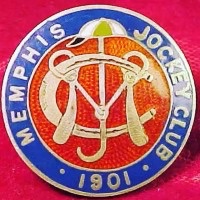
Memphis has always been a city that gathers. Today that usually means Beale Street, FedExForum, or a Saturday at the Liberty Bowl. But in the 19th and early 20th centuries, some of Memphis’ biggest crowds didn’t come for basketball or football. They came for Tennessee horse racing at the racetrack known as Montgomery Park, on the ground that became the Memphis Fairgrounds.
This is the story of how Memphis became a legitimate racing hub, how the Tennessee Derby grew big enough to rival the Kentucky Derby, what actually ended racing at Montgomery Park, and why the name “Memphis Jockey Club” still shows up in racing today.
A Memphis institution dating back to 1836
The Memphis Jockey Club was established in 1836, with meetings held at multiple locations as the city grew. One of the earliest known surviving primary artifacts, a Memphis Jockey Club program from the 1888 Spring Meeting.

By 1851, the club had purchased a large piece of what had been plantation land and developed it into a one mile oval shaped horse-racing track, later expanding facilities with a grandstand and stables.
Montgomery Park and the “New Memphis Jockey Club”
To understand why Montgomery Park mattered, you have to understand the type of money Memphis was producing in that era—and who controlled it.
This is where Col. Henry A. (Henry Arthur) Montgomery (1829–1887) enters the story. Born in Fermanagh County, Ireland, Montgomery built his Memphis career through the infrastructure of the cotton economy, including founding the Merchants’ Cotton Press and Storage Company. In 1882, he organized the New Memphis Jockey Club, a later ownership/operator era that purchased the track and surrounding land and helped cement the venue’s identity as Montgomery Park.

This wasn’t a small-time operation. Historic accounts note a single grandstand, but attendance “would run around 4,000 per race day”—a big crowd for the era and a clear sign this was a major Memphis attraction.
The Tennessee Derby: Memphis’ marquee race with national weight
Montgomery Park’s crown jewel was the Tennessee Derby, a dirt race run in April at the track from 1884–1886 and again 1890–1906.
The one mile oval racetrack became a staple in not only the city, but the entire country as all eyes turned to Memphis every April to watch the worlds best 3-year old Thoroughbreds compete for a shot at glory.
Contemporary summaries describe the Tennessee Derby as rivaling the Kentucky Derby for prestige and purse money in that period.
The purse tells the story. The Tennessee Derby’s prize money varied, but at its peak it reached $9,440 (around $339,000 in today’s dollars) —and the final running on April 24, 1906 (won by Lady Navarre) is the one widely cited with that top figure. That same year, the Kentucky Derby’s purse was only $4,850, which equates to around $174,000 today.
Put plainly: Memphis racing was a big deal.
Newspapers from the era show the scale wasn’t imagined. The Indianapolis Journal reported the Tennessee Derby being run “in the presence of 10,000 people,” calling it the richest event of the meeting.

The end of an era and the Fairgrounds’ next life
Thoroughbred racing at Montgomery Park (including the Tennessee Derby) ended after the 1906 season amid Tennessee’s anti-betting crackdown. the Derby was not reinstated after the 1907 ban.
Even as racing faded, the site’s identity as a public gathering place only grew, setting the stage for the Fairgrounds era Memphis knows today.
Im 1912 the city decided to use it for a permanent park we all now know as the Fairgrounds. Having bought the Montgomery Park buildings from the Jockey Club, architect George Kessler was hired to design the new Fairgrounds.
The name returns

Even though thoroughbred racing in Memphis ended more than a century ago, the Memphis Jockey Club name still lives on in today’s racing world. Michael Kisber and his sons, Zachary and Gabriel keep the Memphis Jockey Club identity visible through their racing silks, which feature the original 1901 pin logo. Notable horses have won in the silks such as Aunt Pearl, who won the $1M Breeders’ Cup Juvenile Fillies Turf (G1) in 2020 and Chili Flag, winner of the 2024 Just A Game Stakes (G1). In 2026, Fitz Right, and City Girl, have both recently won races in these silks.
Ten Strike Racing is also keeping the memory alive. The stable named after Ten Strike, the first winner of the Tennessee Derby is a racing partnership based at Oaklawn Park offering fractional ownership that races at all levels from Claiming to Graded Stakes.
In the end, the story of the Memphis Jockey Club, Montgomery Park, and the Tennessee Derby is a reminder that Memphis once sat squarely in the spotlight of horse racing—with Derby-day crowds, major purse money, and national attention—on the very ground that became the Fairgrounds. While the betting crackdown shut down that era, the name never fully disappeared.
Leave a Reply