
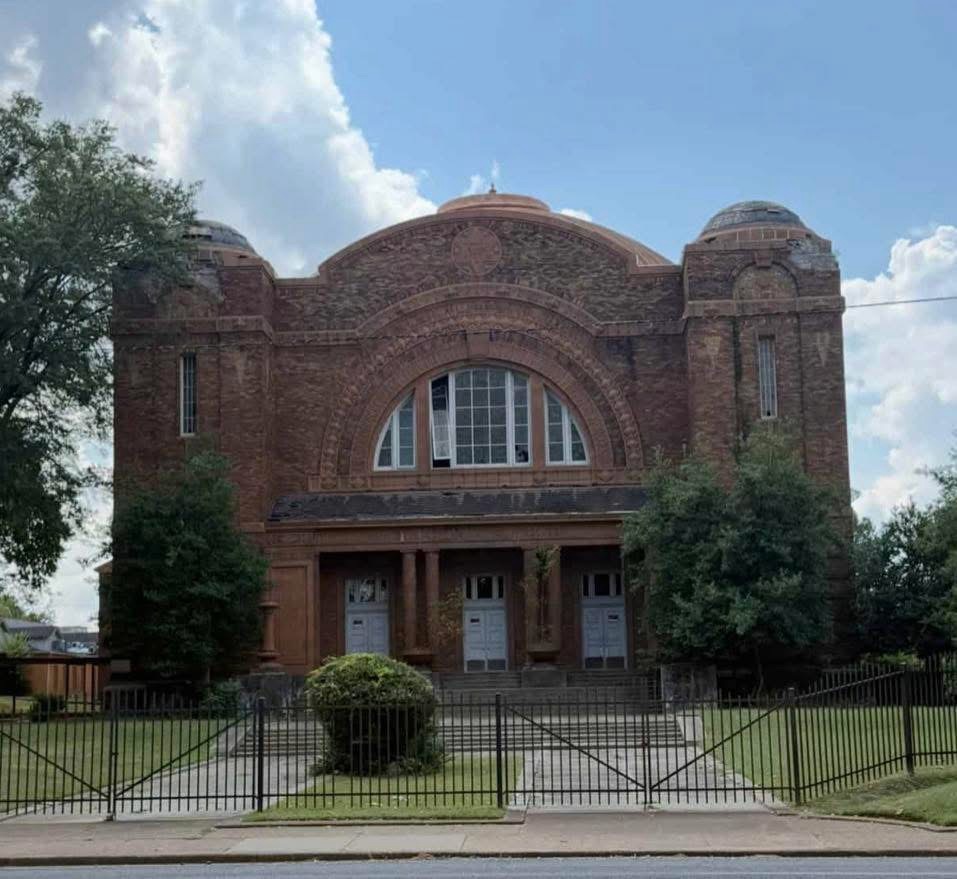
Temple Israel is one of the most important religious institutions in Memphis history. Founded in the 1850s by a small group of Jewish families, the congregation grew from modest beginnings into the oldest and largest Jewish congregation in Tennessee and one of the defining voices of Reform Judaism in the South.
Its story is also tied to one of the city’s most recognizable historic buildings: the former Children of Israel synagogue at 1247 Poplar Avenue. Built in 1916, the Byzantine-style structure was designed by Walk C. Jones Sr. and Max Furbringer, with domed towers, a large arched window, and a sanctuary that reportedly seated 1,200 people.
For decades, that building was home to Temple Israel. It was where generations of Memphis Jews worshiped, learned, gathered, and helped shape the civic life of the city. The building included religious school classrooms, an auditorium, and a prominent inscription from Leviticus over the entrance: “Thou shalt love thy neighbor as thyself.”
That line matters because Temple Israel’s history was never only about worship. It was also about public life.
Temple Israel’s Memphis roots
The congregation began in 1853 as Congregation B’nai Israel, also known as Children of Israel. Its earliest roots were connected to Memphis’ small but growing Jewish community, which had formed the Hebrew Benevolent Society a few years earlier to care for the community and its cemetery.
By 1873, Children of Israel became one of the founding members of what is now the Union for Reform Judaism, placing Memphis in the national story of American Reform Jewish life.
Temple Israel’s rabbis often stood at the intersection of faith and civic responsibility. Rabbi Max Samfield remained in Memphis during the yellow fever epidemics of the 1870s, helping care for the sick and bury the dead. Rabbi William Fineshriber later spoke out against racial violence and the Ku Klux Klan.
That tradition of public leadership would continue into the civil rights era through one of the most important religious figures in modern Memphis history: Rabbi James A. Wax.
Rabbi James Wax and the civil rights movement in Memphis
Rabbi James A. Wax served as Temple Israel’s senior rabbi from 1954 to 1978. He became one of Memphis’ most significant religious voices during the civil rights era, especially during the 1968 sanitation workers’ strike.
During the sanitation strike, Wax was president of the Memphis Ministers Association. He had already been involved in civil rights work for years, including service on the Memphis Urban League board beginning in 1952.
After Dr. Martin Luther King Jr. was assassinated in Memphis on April 4, 1968, Wax joined other ministers in confronting Mayor Henry Loeb, who had resisted the sanitation workers’ demands.
Wax’s words and actions came at a cost. He received both support and condemnation after rebuking the mayor. Some members of his own congregation reportedly discussed removing him from the pulpit, but Temple Israel’s board refused to do so.
That is part of what makes his legacy so powerful. Wax did not speak from a safe distance. He challenged power in the middle of a divided city.
The old Temple Israel building on Poplar Avenue
By 1976, Temple Israel moved east to its current campus on East Massey Road, following the broader movement of Memphis’ Jewish population toward East Memphis.
The Poplar Avenue building was later used by Mid-America Baptist Theological Seminary and then Memphis Academy of Science and Engineering.
Today, the old synagogue is in danger of disappearing. Memphis Heritage says the former Children of Israel synagogue is currently owned by Mississippi Boulevard Christian Church, has fallen into severe disrepair, and is slated for demolition to make way for a new church complex.
That makes this more than an architecture story.
Why this matters for Memphis
This building tells the story of Jewish Memphis, Reform Judaism in the South, interfaith leadership, civil rights, and a rabbi who helped push Memphis toward justice at one of its most painful moments.
If it comes down, Memphis will not just lose an old building. It will lose a physical reminder of a congregation, a movement, and a moral legacy that helped shape the city.
Temple Israel’s story is a Memphis story. Rabbi Wax’s courage is a Memphis story. And the old building on Poplar Avenue is one of the few remaining places where that history can still be seen in brick, stone, and memory.
Frequently Asked Questions
When was Temple Israel in Memphis founded?
Temple Israel traces its roots to 1853, when Memphis’ Jewish community organized what became known as Children of Israel.
Where was the old Temple Israel building located?
The former Temple Israel synagogue, also known as the Children of Israel synagogue, is located at 1247 Poplar Avenue in Memphis.
Who was Rabbi James Wax?
Rabbi James A. Wax was the senior rabbi of Temple Israel from 1954 to 1978 and a major civil rights voice in Memphis during the 1960s.
What role did Rabbi Wax play in the civil rights movement?
Rabbi Wax was president of the Memphis Ministers Association during the 1968 sanitation workers’ strike. After Dr. Martin Luther King Jr. was assassinated in Memphis, Wax helped confront city leadership over the treatment of sanitation workers.
Is the old Temple Israel building being demolished?
The former Children of Israel synagogue on Poplar Avenue has been reported as slated for demolition as part of Mississippi Boulevard Christian Church’s future expansion plans.
Why is the old Temple Israel building important?
The building is important because it represents Memphis Jewish history, Reform Judaism in the South, civil rights leadership, and the public legacy of Temple Israel and Rabbi James Wax.


Leave a Reply