
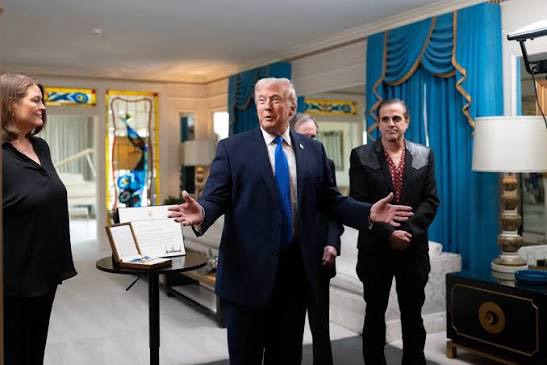
President Donald Trump visited Memphis on Monday, March 23, 2026, for a roundtable focused on the Memphis Safe Task Force, a multi-agency public safety initiative launched in 2025. The stated purpose of the trip was to highlight the task force’s work and the city’s recent drop in crime. The visit also drew protests, comments from local and state leaders, and a surprise stop at Graceland.
Many people are questioning why Trump was in Memphis today, in the middle of a war against Iran, and only two days after a shooting rang out on Beale Street. Despite everything going on, the president came to spotlight what White House officials called the “incredible achievements” of the Memphis Safe Task Force after months of federal, state, and local cooperation on crime enforcement in the city.
Why Trump came to Memphis
According to the White House and local reporting from Action News 5, Trump’s visit was organized around a roundtable discussion about the Memphis Safe Task Force and what officials described as measurable progress since the initiative began. Reuters reported that the task force was launched in September 2025 and includes federal officers, local police, and the Tennessee National Guard.
Action News 5 reported that since the initiative began, officials say the task force has made more than 7,200 arrests, seized nearly 1,200 illegal firearms, and located 150 missing children. Reuters reported that overall crime in Memphis is down roughly 43 percent from a year ago, based on local law enforcement data.
The roundtable included several senior administration officials. Reuters reported that Trump was joined by Defense Secretary Pete Hegseth, Attorney General Pam Bondi, deputy White House chief of staff Stephen Miller, and FBI Director Kash Patel.
What Trump said in Memphis
During the event, Trump argued that Memphis is improving and said the public safety push is working. Reuters reported that he told the crowd:
“You have now developed a reputation as a city that’s coming back stronger than any city in the country because of what’s happened with crime.”
Action News 5 also reported that Trump praised Tennessee and complimented Gov. Bill Lee during the event, while joking that he may need to move to Tennessee one day. The tone of the event was centered on law enforcement results, visible displays of seized evidence, and praise for local and federal collaboration.

Gov. Bill Lee’s words about Memphis
One of the most notable pro-Memphis lines of the day came from Tennessee Gov. Bill Lee. In remarks highlighted by multiple outlets, Lee praised the city itself, not just the task force. He said:
“I do believe, and have believed all my life, that this is a great city, and now it is on a trajectory of greatness.”
That quote stood out because it framed Memphis as a city with long-term potential, rather than only a city being discussed through the lens of crime. Action News 5 also separately summarized Lee’s message with the headline that Memphis is on a “trajectory of greatness.”
A few days before the visit, Lee told Action News 5 that Trump wanted “to see it for himself” and “thank the collaborative teams that have really made this happen.” Lee also said the state plans to keep directing resources toward Memphis, including public safety funding and additional permanent Tennessee Highway Patrol support.
What supporters said about the Memphis Safe Task Force
Supporters of the visit and the task force said the operation has helped improve both safety and confidence in the city. Action News 5 quoted Gady Serralta, director of the U.S. Marshals Service, as saying:
“Crime will not prevail in Memphis. Period.”
The station also quoted Shelby County Republican Party press secretary Luke Cymbal, who argued that crime concerns had affected whether companies wanted to relocate people to Memphis. Supporters gathered earlier in the day at a welcome event organized by the Shelby County Republican Party before the roundtable began.
What critics and protesters said
Trump’s visit also drew criticism and protest. Memphis-area demonstrators and some elected officials argued that enforcement alone is not a complete solution to the city’s challenges. Only two days ago, we experienced another horrific shooting on our most iconic street, Beale St. Separate Action News 5 coverage of the protests reported that critics raised concerns about heavy law enforcement presence, immigration enforcement, and the broader tone of the operation.
Reuters also reported mixed reactions from people in Memphis. Some residents questioned whether the increased police and National Guard presence was concentrated in tourist areas, while others said the larger law enforcement presence had made them feel safer.
The broader debate around the visit was not really about whether crime matters. Everyone agrees it does. The divide is over what should get the most credit for recent improvement and what kind of strategy will create lasting change in Memphis after the spotlight moves elsewhere.
Mayor Paul Young’s response

Memphis Mayor Paul Young did not attend the roundtable. Action News 5 reported that Young said a personal conflict kept him from being there, although he said he had been invited. He also said that while crime is moving in the right direction, the issue is far from solved.
That response matters because it reflects a view shared by many Memphians: recent crime numbers may be encouraging, but public safety is still tied to deeper issues like jobs, housing, neighborhood conditions, and long-term investment.
Trump’s Graceland stop added another Memphis angle
After the public safety event, Trump also made a stop at Graceland, the home of Elvis Presley. That gave the day a second Memphis storyline beyond politics and policing. Even on a day dominated by headlines about crime and security, Memphis’ cultural identity still found its way into the national conversation.

Why this visit matters for Memphis
Trump’s visit matters because it put Memphis at the center of a national political and public safety discussion for a day. It also showed how the city can be viewed in two very different ways at once. To some, Memphis became a case study in crime reduction through aggressive coordination. To others, it became another example of how complicated local problems can get turned into national political messaging.
But one thing is clear: Memphis was not discussed only as a problem. Lee’s “trajectory of greatness” line and the Graceland stop both reinforced that the city is bigger than the toughest parts of its reputation. Memphis remains a place of culture, identity, resilience, and national significance.
For readers looking for the plain facts, that is the real takeaway from March 23, 2026: Trump came to Memphis to promote the Memphis Safe Task Force, praise falling crime numbers, meet with officials, and project the city as a public safety success story. Whether that narrative fully captures Memphis is something residents will keep debating long after the motorcade is gone.
Sources
- Reuters: Trump visits Memphis to tout crime-fighting efforts
- Action News 5: Pres. Trump visits Memphis, touts task force shift on crime
- Action News 5: Tennessee governor talks President Trump’s visit to Memphis
- White House Live: President Trump participates in the Memphis Safe Task Force roundtable
- White House article on the Memphis Safe Task Force

Leave a Reply