
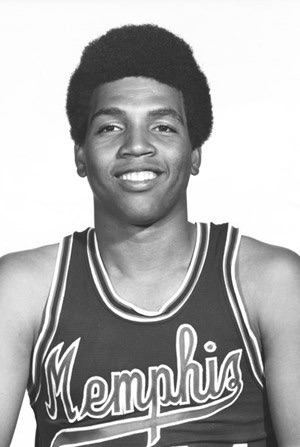
Larry Finch was born on February 16, 1951, and if you want the cleanest way to explain his legacy, it is this: he was Memphis, all the time. From Orange Mound to Melrose High School to Memphis State, Finch became the face of a program and a city that saw itself in him. Decades later, his name still carries weight because he did it all here. He starred here, he stayed here, and he came back to lead the Tigers from the bench.
A hometown kid who became a Tigers scoring standard
Finch played three varsity seasons at Memphis State (1970 to 1973) and finished with 1,869 career points, a total that remains fourth all time in program history. Even more impressive is the efficiency of it: his 22.3 points per game career average is still the Memphis program record, a level of sustained scoring that has proven almost impossible to touch.
Memphis’ own athletics bio notes how his scoring climbed as his career went on, including a 24.0 points per game senior season with 723 points, and that he finished as the school’s career scoring leader at the time.
Finch was not just a great Tiger. He was nationally decorated too, earning Consensus second team All-American recognition and becoming a symbol of Memphis State’s rise on the national stage in the early 1970s.
The 1973 title game and the moment that captured who he was
If you grew up on Memphis basketball stories, you already know the headline: the 1973 Tigers made the national title game. Finch was the engine of that run, and in the championship game against UCLA, he scored 29 points, while UCLA’s Bill Walton delivered a now legendary performance.
Walton finished with 44 points and an almost unreal 21-for-22 shooting night as UCLA pulled away late for an 87–66 win.
But for Memphis, one of the most remembered moments from that night is not a stat. It is a choice.
Late in the game, Walton went down with an injury. In an era when the stakes were massive and emotions ran hot, Finch helped him up, and Finch walked his limping opponent back toward the sideline. Writers later described it as a snapshot of Finch’s sweetness and public spirit, a sportsmanlike moment that still resonates because it looked like Memphis at its best.
That is the part people pass down. Finch competed like a star, and carried himself like a pro.

Staying home: the ABA years in Memphis
After college, Finch was drafted by the Los Angeles Lakers, but he chose a path that fit his personality and his city. He stayed home and played professionally in the American Basketball Association for the Memphis Tams and later the Memphis Sounds.
His pro career was brief, but the symbolism mattered. Memphis did not just claim Larry Finch. Larry Finch claimed Memphis right back. He wanted his career, his name, and his daily life tied to home.


The return to the Tigers and the coach who shaped an era
Finch moved into coaching almost immediately after his playing days, eventually returning to Memphis as an assistant and then becoming head coach in 1986, a tenure that lasted through 1997.
His record as Memphis head coach was 220–130, and multiple sources note he led the Tigers to six NCAA Tournament appearances, including a deep run to the Elite Eight in 1992.
And here is where Larry Finch’s story connects straight into today.
Finch recruited and coached local stars, including Anfernee “Penny” Hardaway, and the program’s modern identity of Memphis talent choosing Memphis has always traced back to Finch’s example. In a University of Memphis magazine feature, Penny called Finch “the native son” and credited him as a reason players like Penny wanted to come to Memphis, describing Finch’s life as a full arc from player to assistant to head coach.

Now Penny is the head coach, carrying that same idea forward, that Memphis basketball can be built with Memphis pride at the center. Finch coached Penny, and Penny is coaching the Tigers. That is not just a fun connection. That is lineage.
Why Larry Finch still matters in Memphis
Larry Finch’s greatness is easy to measure with numbers: 1,869 points, 22.3 points per game, a Final Four run, and 220 wins on the sideline.
But his real impact is what those numbers meant to people in this city. Finch represented unity, belonging, and a certain Memphis confidence. Even in the biggest moment, when the championship slipped away, he still chose respect and sportsmanship, helping a wounded opponent to the sideline.
Larry Finch was Memphis basketball, but he was also a reminder of something bigger: the greatness that can come out of our neighborhoods, our schools, and our city when talent meets belief and character. He lived “Memphis first” before it was a slogan.
And every time a kid in this city dreams of Tiger blue, that legacy is still doing its job.

Leave a Reply