
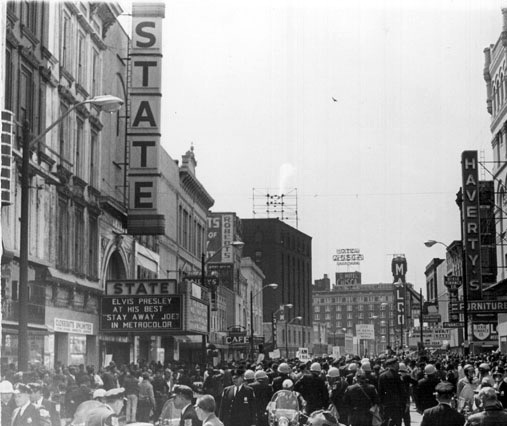

On October 7, 1920, Memphis welcomed one of its most ambitious and elegant film palaces: Loew’s State Theatre, at 152 South Main Street, just a couple blocks from the Chisca Hotel.
Vision & Design
Constructed at a moment when downtown Memphis was expanding its cultural footprint, Loew’s State was built by Loew’s Inc. and designed by prominent theater architect Thomas W. Lamb.
Because Main Street frontage was limited, the theater’s entrance had to be ingeniously inserted into a row of storefronts. A long lobby—some sources say 150 feet—led patrons past a grand marble staircase, bridging an alley, and into the auditorium. Inside, the style drew on Adam and Renaissance Revival influences: columns, arched mirrors, stained-glass light fixtures, and plaster chandeliers weren’t just decorative—they elevated the entire experience.

Amenities & Innovations
The original seating capacity was 2,566—a size signaling that Memphis was ready for big, first-run motion pictures. Early on, the theater was equipped with a Moller organ (3 manuals, 17 ranks) at a cost of $6,450, to accompany silent films and provide live performance interludes. In 1926, this was upgraded to a Wurlitzer organ (3 manuals, 11 ranks).
Loew’s State also served as a stage venue when needed, hosting local events beyond film screenings. Over the years it was adapted for “talking pictures,” and its marquee evolved—from a stately vertical display to a modern neon-lit frontage.
A Role in Memphis History
Loew’s State was more than just a theater; it’s woven into Memphis’s cultural fabric. Notably, Elvis Presley worked there briefly in 1948 as an usher—an early brush with the stage that predates his legendary rise. Over its lifetime, the theater hosted premieres, big bands, and stand-alone film showings of classics like Gone With the Wind and The Great Ziegfeld.
By the 1960s, the theater began to decline in prominence as multiplexes and suburban cinemas took hold. In 1964, Loew’s Inc. sold the theater to Gulf States Theatres, and over time the “Loew’s” name was partially masked in signage, reflecting changing ownership and branding.
Closing & Demolition: The End of an Era
The theatre closed on November 28, 1970, with WUSA starring Paul Newman the last film shown. In the years after, urban renewal efforts swept through downtown Memphis. The block that housed the theatre was largely razed.
Significantly, Peabody Place Avenue was cut through the very block that once held the theater’s entrance — today, the street grid itself is partly shaped by the demolition. By the early 1970s, almost all adjacent structures were obliterated, and the State Theatre left no standing trace

Leave a Reply