
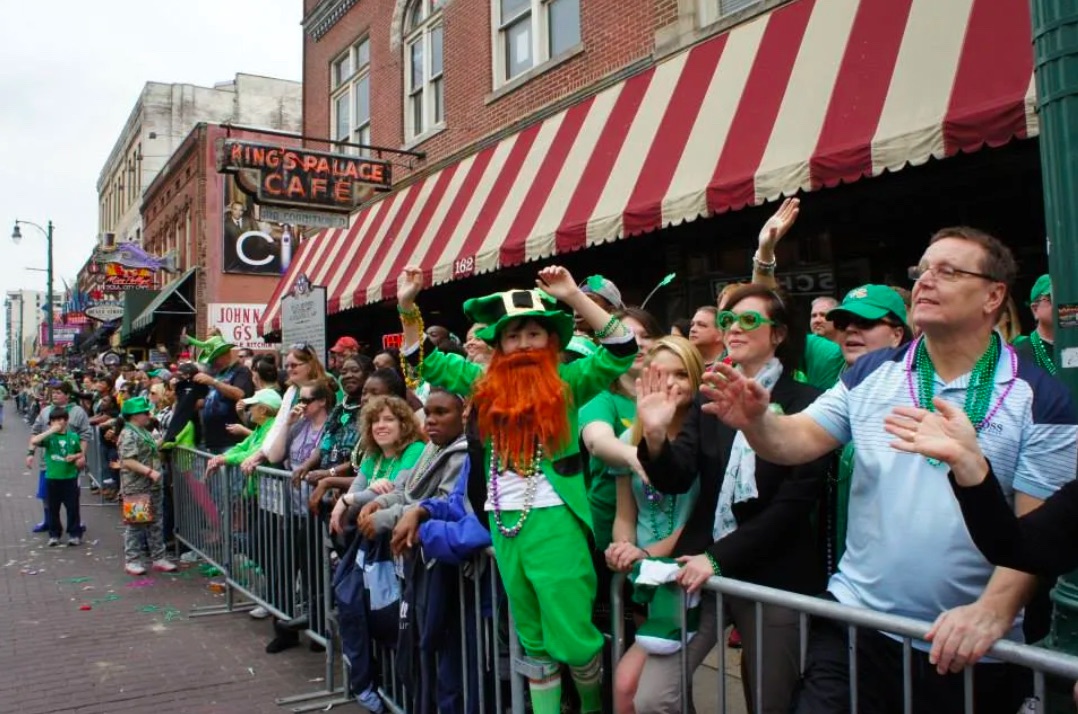
St. Patrick’s Day in Memphis is more than green beer and Beale Street. It is also a chance to remember how Irish immigrants helped build Memphis, from early neighborhoods and churches to schools, labor, and civic life. In the 1800s, the Irish were one of the largest immigrant groups in Memphis, and that story still shows up today in places like St. Patrick’s Catholic Church and in traditions like the annual Silky Sullivan St. Patrick’s Parade on Beale Street.
In 1860, more than one-third of white Memphians were foreign-born, and one local history account says about 4,000 of them were Irish workers. They were a major part of the city’s early working class and helped power Memphis during a period of fast growth along the river.
The Irish were woven into early Memphis
One of the clearest examples of Irish Memphis is the Pinch District. The neighborhood’s old nickname, “Pinch-Gut,” has long been tied to poor Irish immigrants and their hard conditions in early Memphis. It was a struggling area, but it also became one of the city’s most important immigrant neighborhoods.
The Irish also helped shape Memphis institutions. Local Memphis tourism history notes that Eugene Magevney, an Irish immigrant from County Fermanagh, helped establish Memphis’ public school system and also helped found St. Peter’s, the city’s first Catholic church. That matters because it shows the Irish story in Memphis was never just social. It was structural. It helped build part of the city’s civic foundation.

St. Patrick’s Catholic Church became another major anchor of that legacy. It was founded in the 1860s to serve the city’s growing Irish working-class population and remained a major parish for Irish Memphians well into the 20th century.
The Irish story in Memphis also carries real pain
This history is not all celebration. It also includes hardship, disease, and loss. The yellow fever epidemics of the 1870s devastated Memphis, and the Irish community was hit especially hard because many poorer residents could not afford to flee the city like wealthier Memphians could.
That suffering shows up in one of the best-known Irish-connected stories in Memphis history. Mary Harris Jones, later known to the country as Mother Jones, lived in Memphis and lost her husband and four children to yellow fever before becoming one of America’s most famous labor organizers. It is one of the sharpest reminders that the immigrant story in Memphis is about survival as much as celebration.

Why Irish American Memphis still matters
Irish Memphis is not frozen in the 1800s. Its legacy still shows up in churches, family names, local traditions, and public celebrations. The Memphis Irish Society remains active, and each March the city still leans into that heritage with events tied to St. Patrick’s Day.
That is where Silky O’Sullivan’s enters the story.
The history of Silky O’Sullivan’s in Memphis
Silky O’Sullivan’s is one of the most recognizable Irish bars in Memphis, but it is more than a gimmick stop on Beale. It has become one of the city’s best-known St. Patrick’s Day institutions and one of the most recognizable Irish-themed destinations in Memphis nightlife.
According to Silky O’Sullivan’s, the business was established in 1973, with its original location on Madison Avenue in Overton Square in Midtown. It later became one of the early businesses to help energize the revived downtown entertainment district, opening on Beale Street in 1992.

Its current Beale Street home is part of the appeal. Silky’s says the building is more than 100 years old and has a long history on Beale. That layered setting helps explain why the place feels bigger than just a bar on parade day. Whether people come for the piano bar, the patio, or the general chaos, the setting itself is part of the story.
Silky’s also built a brand around being weird in the most Memphis way possible. It is known for dueling pianos, giant drinks, a courtyard full of handprints, a piece of the Blarney Stone embedded in the wall, and of course the goats. That mix of Irish theme, showmanship, and Beale Street energy is exactly why the place stuck. It is not trying to be a quiet Dublin pub. It is a loud, theatrical, very Memphis version of Irish celebration.
How Silky’s became part of Memphis St. Patrick’s Day tradition
Silky O’Sullivan’s is now tied directly to one of the city’s signature St. Patrick’s celebrations. The 53rd Annual Silky Sullivan St. Patrick’s Parade is set for Saturday, March 14, 2026 at 2 p.m. on Beale Street, with marching bands, floats, dancers, decorated vehicles, and community groups. Memphis tourism officials describe it as the city’s oldest continuously running parade.
That matters because it shows how a bar became part of the city’s living calendar. Silky’s is not just using Irish imagery for décor. It became one of the places where Memphis performs its version of Irish American identity in public every March.
Things to do in Memphis this weekend for St. Patrick’s Day
Looking for St. Patrick’s Day events in Memphis this weekend? Here are a few worth checking out:
- Silky’s St. Patrick’s Day Parade on Beale Street — Saturday, March 14 from 2 to 4 p.m. Hands down the biggest and most recognizable St. Patrick’s Day events in Memphis.
- Hooligan Irish Red Ale Release Party at Flyway Brewing — Saturday, March 7 starting at noon. Flyway is bringing back its Hooligan Irish Red Ale with live Irish music, dancing, and food.
- St. Patrick’s Day Irish Tea Service at The Peabody — Saturday and Sunday, March 14–15 from noon to 3:30 p.m. Expect an Irish-inspired afternoon tea in Chez Philippe.
- St. Patrick’s Day Early Celebration at The Dame — Saturday, March 14 at 1 p.m. A more tucked-away St. Paddy’s option with drink specials, live music, and patio energy.
- Slider Inn Downtown & Midtown St. Paddy’s — Saturday, March 14, all day. Both locations are going big with live music, DJs, green beer, and Jameson specials.
- Lucas St. Patrick’s Day Parade in Cooper-Young — Tuesday, March 17 with lineup at 4:30 p.m. and step-off at 5 p.m. This is the only Memphis parade actually held on St. Patrick’s Day itself.
- Celtic Crossing St. Patrick’s Day celebration — Tuesday, March 17 from 11 a.m. to 9 p.m. One of Memphis’ best-known Irish pub traditions with live music, dancers, bagpipers, and a beer garden.
- Swamp Sessions with Yo Breezye at Swamp Bar — Tuesday, March 17 at 7 p.m. A patio set with drink specials and no cover.
Missing something we should add? Email us at hello@thisismemphis.co.
A Memphis story with Irish roots
The story of Irish immigrants in Memphis is bigger than one holiday. It is the story of laborers, teachers, priests, families, and neighborhoods that helped shape the city during its early growth. It is also the story of communities that endured poverty, disease, and exclusion, then still left behind institutions and traditions that outlasted them.
And then there is the modern layer. A bar like Silky O’Sullivan’s, with its goats, piano singalongs, and parade-day energy, is not the whole Irish story in Memphis. But it is part of how that story stayed visible. It turned heritage into ritual, and ritual into something Memphians now expect every March.
St. Patrick’s Day in Memphis is fun and also points back to something deeper. Irish immigrants helped build this city, and their legacy is still here in churches, memory, neighborhood history, and Beale Street tradition.
Sources: Memphis Travel, Beale Street Memphis, Memphis Irish Society, Downtown Memphis, and Downtown Memphis.



Leave a Reply